

Celebrating International Sign Language Day and the Power of Connection
A conversation can begin with a raised eyebrow, a handshape, a facial expression, or a movement through space. That is part of the beauty of sign language. It reminds us that human connection has never belonged to sound alone.
Every year on September 23, the world recognizes International Sign Language Day, more widely known through the United Nations as the International Day of Sign Languages. It is a day to celebrate the rich languages used by Deaf communities, honor the people who keep those languages alive, and notice how communication grows when more of us make room for different ways of being understood.
Sign language is not a backup plan for spoken language. It is language in full, with grammar, rhythm, humor, poetry, regional variation, and culture. It carries stories across generations. It helps children learn, families bond, friends laugh, and communities organize. Most of all, it connects people.

Sign language is a living language, not a single universal code
One common myth is that there is one sign language used everywhere. There is not. Just as spoken languages differ across countries and cultures, signed languages do too.
In the United States and parts of Canada, many people use American Sign Language, or ASL. In the United Kingdom, people may use British Sign Language, or BSL. These are not the same language, even though both are signed. They have different grammar, histories, and signs. Around the world, Deaf communities use many distinct signed languages shaped by local culture, education, migration, and community life.
There is also something called International Sign, often used at international Deaf events. It helps people communicate across language backgrounds, but it is not the same as a full natural language rooted in one community. That difference matters because it reminds us to respect signed languages as real languages, not simplified gestures.
A signed language uses the whole body. Hands matter, but so do:
Facial expressions
Eye gaze
Body position
Movement
Space
Timing
Context
A small shift can change meaning. A raised eyebrow might mark a question. A repeated motion might change a verb. A movement from one point in space to another can show who did what to whom. Sign languages do not simply copy spoken-language word order onto the hands. They have their own structure.
That is part of what makes them beautiful. They show how flexible and creative human language can be.
September 23 invites celebration and reflection
September 23 was chosen because it marks the founding date of the World Federation of the Deaf in 1951. The day is a celebration, but it also carries a clear reminder: language access is a human rights issue.
For many Deaf people, sign language access shapes daily life. It can affect education, healthcare, public services, emergency information, employment, family communication, entertainment, and community participation. When access is missing, people are not simply inconvenienced. They may be excluded from information and decisions that affect their lives.
Celebrating this day means more than posting kind words. It means asking practical questions.
Can a Deaf child learn in a language they can fully access?
Can a patient understand a doctor without relying on a family member to interpret?
Can public announcements reach Deaf residents during emergencies?
Can a theater performance, museum tour, or community event include sign language interpretation?
Can hearing family members learn enough sign language to communicate directly with a Deaf child, sibling, parent, friend, or neighbor?
These questions point to a larger truth. Connection requires effort from both sides. Deaf people should not have to carry all the work of making communication possible.

The beauty of sign language lives in culture and community
Sign language is often described in practical terms, especially by hearing people. They may focus on access, interpretation, captions, or classroom support. Those things matter deeply. Still, sign language is also art, identity, memory, and belonging.
Deaf culture has its own traditions, values, humor, storytelling styles, and social norms. Many Deaf people do not view deafness only through a medical lens. For people who identify with Deaf culture, sign language can be a source of pride and community.
Signed storytelling can be stunning. A skilled signer can shift roles, show movement, build suspense, and create a visual scene without a single prop. Signed poetry can use symmetry, rhythm, handshape, and space in ways that spoken-language poetry cannot. A joke in sign language may depend on visual timing, facial expression, or a clever twist in movement.
Those forms deserve appreciation on their own terms.
This is also why representation matters. When Deaf children see Deaf adults signing with confidence, leading classrooms, performing on stage, working in public roles, raising families, and sharing stories, they see possibility. When hearing people see Deaf language and culture represented with care, they learn to move past pity and toward respect.
Celebration should never flatten the community into one story. Some Deaf people use sign language as their primary language. Some use spoken language, hearing technology, writing, cued speech, captioning, or a mix of tools. Some are hard of hearing. Some are late-deafened. Some are DeafBlind and use tactile forms of communication. Identity and access needs vary.
Respect starts with listening, and in this context, listening may mean watching, learning, and following the lead of Deaf people.
Small choices can make communication more inclusive
International Sign Language Day is a good time to think about daily habits. Many inclusive choices are simple, but they can change the tone of an interaction.
If someone signs, do not look away from them and speak only to an interpreter. Look at the person you are communicating with. The interpreter supports access, but they are not the center of the conversation.
If you do not know sign language, be honest and patient. Use writing, gestures, a notes app, captions, or another agreed method. Do not pretend to understand. That can create confusion, especially in serious situations.
If you are organizing an event, think about access early. Waiting until the last minute can make it hard to find qualified interpreters or prepare materials. Clear lighting also matters because people need to see hands and faces. Captions, visual alerts, seating choices, and quiet spaces can help too.
Here are a few practical ways to honor the day:
Learn basic signs from Deaf-led resources
Start with greetings, introductions, and everyday phrases. If learning ASL, learn from qualified Deaf teachers whenever possible.
Support Deaf creators, educators, and artists
Watch their work, attend events, buy their books or art, and share their projects with credit.
Add captions when sharing videos
Captions help Deaf and hard-of-hearing viewers, and they also help people in noisy places, quiet rooms, or second-language settings.
Book qualified interpreters for public-facing events
Family members or coworkers should not be expected to interpret complex, private, or formal information.
Teach children that communication comes in many forms
This builds respect early and makes inclusion feel normal, not special.
These steps are not about perfection. They are about showing that communication is shared work.
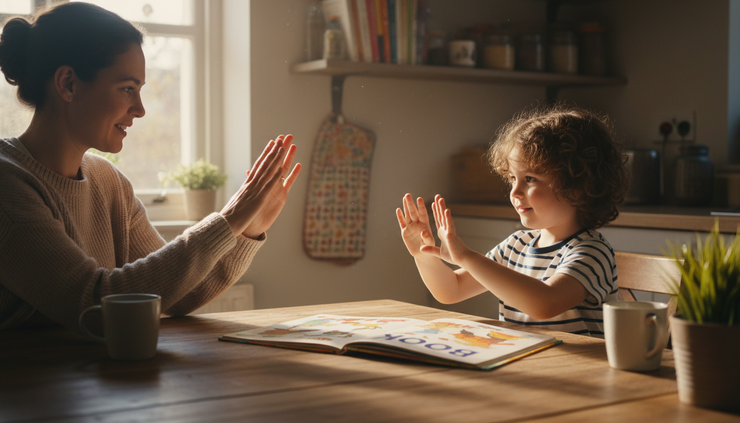
Learning sign language opens a door to deeper connection
Learning a signed language takes time, practice, humility, and consistency. A few signs can be friendly, but true fluency means learning grammar, culture, and context. It also means accepting correction.
That is a good thing. A language is not only a set of words. It is a way people make meaning together.
For hearing people, learning sign language can change how communication feels. It can make facial expression feel less like decoration and more like grammar. It can make silence feel less empty. It can show how much we communicate with our bodies already, even when we do not notice it.
For families with Deaf children, early access to a full language matters. Children need language they can interact with naturally and often. Sign language can support bonding, learning, emotional expression, and participation at home and school. Families do not need to know everything at once. They need to begin, keep going, and build a communication-rich environment.
For friends, neighbors, teachers, coaches, librarians, healthcare workers, and community volunteers, even basic awareness can reduce barriers. A person who knows how to get attention respectfully, maintain eye contact, use clear visual cues, and avoid speaking over someone has already made the space more welcoming.
A few respectful habits help:
Gently wave or tap a shoulder to get attention, if appropriate.
Face the person while communicating.
Keep your mouth, hands, and face visible.
Avoid standing in front of bright backlighting.
Ask what communication method works best.
Be patient when repeating or clarifying.
These small actions say, “I want this conversation to include you.”
Inclusion grows when access becomes normal
Too often, access is treated like an extra request instead of a basic part of planning. International Sign Language Day asks communities to imagine something better.
Imagine public events where captions and interpreters are planned from the start. Imagine schools where Deaf children can learn from Deaf role models and qualified teachers. Imagine hospitals where language access does not depend on luck. Imagine family gatherings where a Deaf relative is not left out of jokes, stories, and quick decisions. Imagine emergency alerts that reach everyone clearly.
None of this is impossible. It starts when people stop seeing access as charity and start seeing it as respect.
Sign language also offers a broader lesson. It shows that connection is not limited to one mode. People connect through speech, sign, touch, writing, facial expression, technology, shared routine, and care. A community becomes stronger when it values all of those paths.
That is why this day is both joyful and practical. It celebrates language, beauty, culture, and pride. It also calls for better systems, better habits, and better listening.

A day to celebrate, and a reason to keep learning
September 23 is a chance to say, with joy and respect, that sign languages matter. They matter because Deaf people matter. They matter because every person deserves access to language, information, culture, and community.
The power of sign language is not only in the hands. It is in the eye contact, the shared attention, the facial expression, the patience, the laughter, and the decision to meet someone in a language they can fully use.
Celebrate International Sign Language Day by learning something, sharing something, or changing one habit that makes communication more open. A single day can honor the beauty of sign language. What we do after that day shows how deeply we value connection.


Comments